You have no items in your shopping cart.


An in-depth review of the CMC MPD as used as a braking device for a slackline pulley system. We test the MPD side-by-side with the Petzl I'D, which has been the industry standard advanced braking device for several years.
For the first few years of my slackline career I have used the same Petzl I'D as my longline pulley system brake. I thought that it was as good as the brake could ever get until I got my hands on the CMC Multi Purpose Device (MPD). This device was meant to hold some serious loads, which makes it a fantastic device for braking a pulley system.
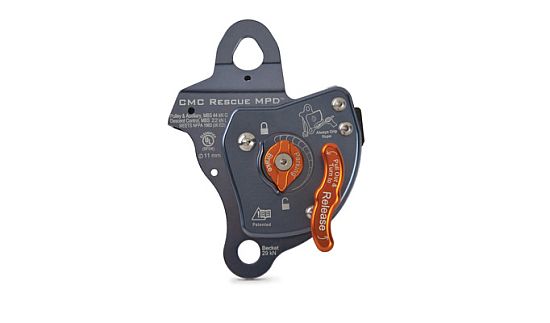
Some things that I noticed right when I received the MPD:
The Bag
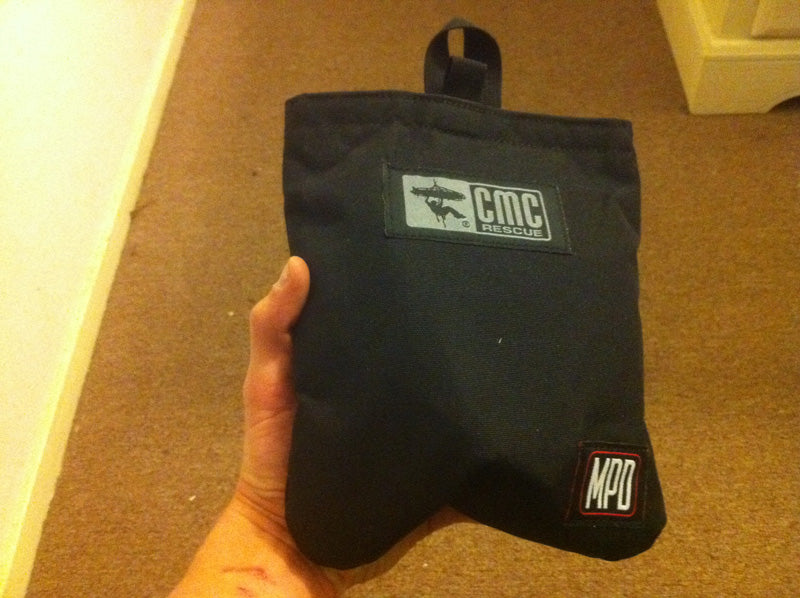
It comes with a very nice canvas bag that has an attachment loop on the top so that you can clip it to your pack or harness. This bag has some very nice padding on the inside of it and is fastened shut with what feels like a SUPER strong hook and loop (velcro). I'm not usually one that keeps their gear in individual bags, but this piece of hardware deserves this kind of special bag and the quality of the device extends to the bag it comes in.
The Sheave
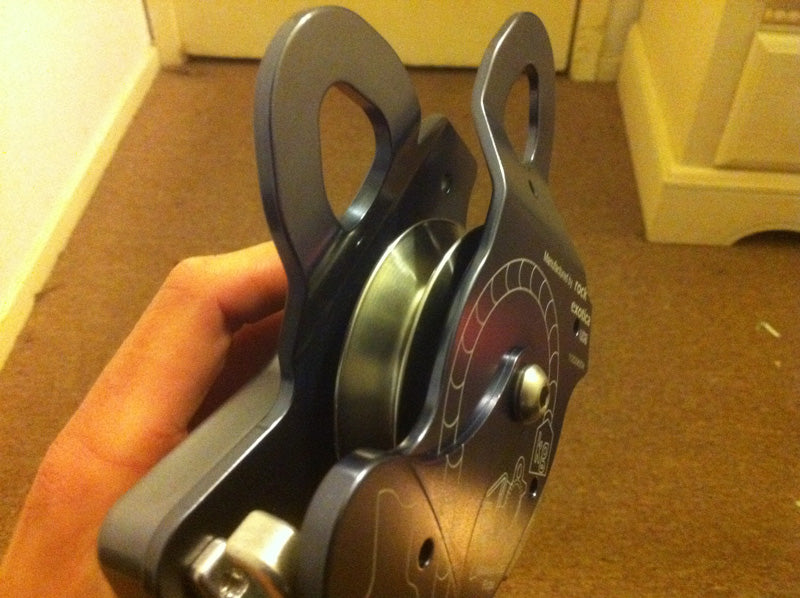
Inside the brake there is a 3" sheave which only spins in the direction of the force. This means that when you are tensioning your line, the sheave inside the brake will spin with the rope, causing there to be very minimal friction (the bearings are AMAZING inside this device). But, when you detension with the MPD, the sheave inside will not spin, thus causing more friction around this sheave, which makes letting out tension a LOT smoother. In the test we ran below, there was 464 lbs of tension on the brake, but releasing it felt like there was almost no force...incredible!
The Parking Brake
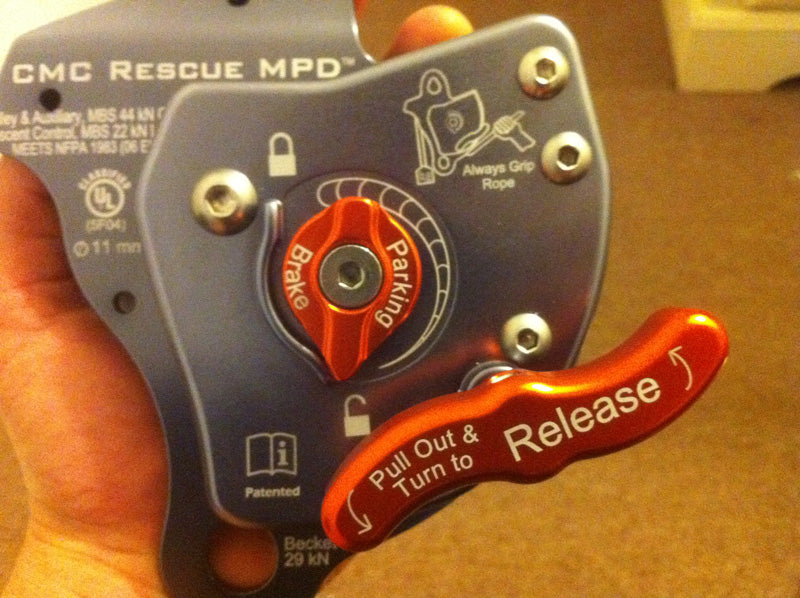
Next on the list of features is the parking brake. This nifty little contraption actually cinches the cam down onto the rope to virtually stop all slippage from occurring. When you are done tensioning and want to start walking your line, this will ensure your pulleys don't go anywhere. Other braking devices have similar features, but they aren't nearly as secure as this.
The Becket
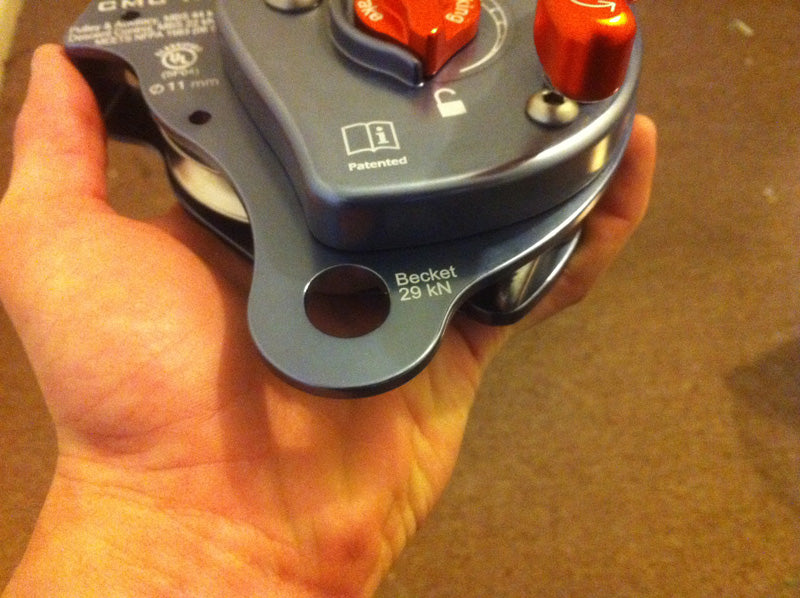
The MPD also has a becket built into it that has a 29 kN (6,519 lbf) 3-sigma Minimum Breaking Strength (MBS). This is extremely handy for when you want to have more than just a 3:1 multiplier on your pulley system. In situations where there is a downhill slope coming away from the tension tree I will also connect a single pulley to the anchor to redirect the rope away from the tree so that I can run down the hill to tension. Having the becket on the brake will make this so much more simple.
The Friction Hook

Another amazing feature is the rope notch and additional friction hook which is used when detensioning. Basically, you just redirect the rope tail around the notch and through the hook to add friction when you want to release tension. In the test I did there was 464 lbs of tension on the MPD and releasing it was absolutely no problem at all. I could see releasing tension up to 3x higher than this without any troubles.
The Release Handle

One of the coolest things that I noticed about the CMC MPD is the tension release handle. This thing is amazing. To release tension, you must pull on the handle and rotate it at the same time. With this method combined with the friction hook, you can easily control the speed at which you let the tension out of your line (even at outrageously high tensions). Also, since you have to pull on the handle for it to engage, it's literally impossible to accidentally release tension with the MPD. No other braking device out there has something that is comparable to this. Simply incredible.
The Build Quality
Another thing about the MPD that just cannot be conveyed by pictures is the build quality. When you hold this marvelous piece of gear in your hands you can tell that serious thought and precision went into manufacturing it. It feels very sturdy, extremely durable, and just solid. I would have no problem trusting my life to this piece of gear when used as a brake for my pulley system.
That's all for the in-depth look at the MPD. Let's see how it works in the field!
The Experiment!
What I did in this next part is compare the MPD side-by-side with the Petzl I'D, which I have been using as our brake for many years. I setup a 316 ft. (96m) line with Mantra MKII using a 5:1 pulley system with the SMC 3" Double PMP's. First, I rigged the line using the Petzl I'D as the brake. The goal was to get to 2,500 lbs (11 kN) of tension in the line, which would mean that the I'D would be holding roughly 500 lbs of tension. I wanted this tension because I knew from experience that this is when it gets hard to release tension from the I'D. After rigging the line with the I'D, I derigged the line with the I'D and then rerigged it with the MPD, going to the same tension as before. My goal was to compare the difficulty in tensioning as well as detensioning for both brakes at approximately the same tensions on the same setup.
After rigging the line with the I'D as the brake, I was totally exhausted. The final pulls were extremely difficult. I could really feel the friction inside the brake and it was making it hard for me to get to my target of 2,500 lbf. I made it though!
I then let the webbing relax a bit (by relax I mean I walked the line a few times), then I detensioned the line with the I'D. By now the tension had dropped all the way down to 2,070 lbf, which meant that there was approximately 414 lbs of tension on the I'D. The initial opening of the brake was quite hard and the rope made a very sudden jerk which could have been disastrous had I not been holding on to the tail very well. Once the initial opening was done, letting tension out was very easy.
Now it was time to tension with the MPD as the brake. Since there is a sheave inside the MPD, I was able to tension the line just by pulling on the tail from the MPD. I got the line to 900 lbf from this method alone! That's incredible power! There is no way that I could do that with any other braking device.
Getting to 2,500 lbf was so simple using the MPD, I could have easily gone another 1,000 lbs without any problems. The difference between the two devices during tensioning is amazing. I don't think I can ever use my I'D on big lines anymore...
Detensioning with the MPD was noticeably easier as well. By utilizing the notch and friction hook during detensioning, I was able to release the tension with almost no effort. The tension in the line at time of release was 2,320 lbf which means there was 464 lbs of force on the MPD. No problem!
After this experiment I can honestly say that MPD is the superior braking device on the market. In comparison to the Petzl I'D, which is our industries current 'high-end' braking device, it simply on a whole other level. The only downsides of the MPD that I can see are the price, the weight, and having to remove the entire device to install the rope. On all other aspects, the MPD is the winner.
You can definitely expect to see the MPD carried in the BC Shop in the near future. All you hardcore slackliners out there, I HIGHLY suggest that you get yourself one of these, you will not regret it.
Here is a nice chart with the specs of the MPD side-by-side with the Petzl I'D, just for comparison:
| Brake | Braking Method | Ease of Tension Release | Strength | Weight |
|---|---|---|---|---|
| Petzl I'D | Camming Method | Very Easy to Easy | Under 550 lbf | 530 grams (18.7 oz.) |
| CMC MPD | Camming Method | Extremely Easy to Very Easy | Under 21 kN | 1,100 grams (38.8 oz.) |

← Older Post Newer Post →
0 comments