Breadcrumbs
Home / Slack Science / Slack Science / All About Pulley Systems - Part 5 - Multiplier Characteristics
Slack Science, powered by Balance Community: Slackline Outfitters, is a blog run by Jerry Miszewski about slacklining. He offers tips and tricks to various parts of setting-up, taking down, in-depth looks at various aspects of a setup, and hints at walking slacklines.
Jerry's long history with the sport of slackline has given him a wealth of knowledge that he loves to share with his fellow slackliners. Slack Science is a place anyone and everyone to come and learn about our wonderful sport of slacklining.
All About Pulley Systems - Part 5 - Multiplier Characteristics
- Hits: 2434
- 2 Comments
- Subscribe to updates
After looking at the main pulleys and the brake for our pulley systems, it's time to dive into the subject of multipliers.
The multiplier part of your pulley system is an essential component that is often overlooked. This is the part of your pulley system that will be adding the most mechanical advantage, so it's very important to get quality components that will ensure you get the least friction possible.
First off, I want to explain the multiplier concept a bit, as it can often be very confusing. Basically, a multiplier is just another pulley system that is attached to your main pulley system. For instance, if you have a set of double pulleys for your main pulleys setup in a 5:1 configuration (the rope starts on the line side rather than the tree side), and you have a single pulley for your multiplier, what you are basically doing is grabbing onto the last rope coming into the brake system and attaching a pulley system here. This makes pulling on this rope 3 times easier than just grabbing onto the rope and pulling. Thus, you are multiplying the whole mechanical advantage by 3! This is a very large increase over our previous 5:1 mechanical advantage. Our total theoretical mechanical advantage is now at 15:1. If you are not familiar with this syntax, what that means is that for every 100 lbs of force you pull on the tail of your pulley system, 1500 lbs is being applied on the connection point from your pulleys to the line. This is a great way to approximate the tension in your line, by estimating the force you are applying to the tail of your pulley system rope, but that's a whole other topic.
Now on to the actual components of the multiplier. A multiplying system consists of 3 basic components: a rope grab, a connector, and a pulley. Some very basic multipliers will drop or combine one of these components, but the concept is still the same. I will go into depth about each of these components below.
The Rope Grab
There are various devices and methods for this part of the multiplier, each with their pros and cons. The thing to remember is that this point in the system will be experiencing shock-loads of force that is equal to two times whatever you (and your friends) are pulling on your rope. This can be potentially hazardous to your rope if you do not have a good device. I will describe three basic methods for grabbing the rope with products offered at Balance Community that use these methods.
Camming Rope-Grab
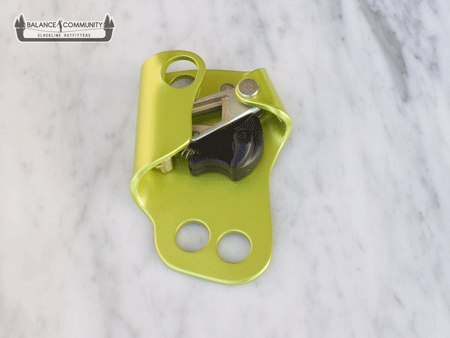
Some rope-grabs on the market have camming units with sharp teeth for grabbing the rope. These devices work extremely well if used correctly, but can also destroy your rope if used incorrectly. They are usually a bit more pricey, but are highly effective for multiplier rope-grabs. The product that we will look at is the Petzl BASIC Multi-Purpose Ascender.
The cool thing about this rope-grab is that it's very easy to use and can be installed anywhere along the rope without any trouble what-so-ever. It's also got a strength rating of 4 kN on smaller ropes (8-9mm), all the way up to 6.5 kN on larger ropes (12-13mm). These forces are virtually impossible to exceed when pulling your pulley system tail with a 3:1 multiplier installed.
Another nice feature of the BASIC is that the front hole is great for installing a pull-chord for resetting your multiplier after pulling it all the way to the brake. This is a handy thing, especially when the anchors for your line are well above your head.
Yet another reason why the BASIC is the superior rope-grab is that the top of the device is extremely low profile, which makes it great for avoiding the knot on the line-side of your pulley system. Some rope-grabs are very tall and tend to get stuck on the knot, which can cause them to not grab the rope properly and potentially rip the sheath off of your rope.
Here are some specs for the device:
- Method of Grabbing? : Camming Unit
- Slipping Load: 4 kN - 6.5 kN for 8mm - 13mm ropes respectively.
- Weight: 4.76 oz. (135 grams) - Individually Tested
- Acceptible Rope Sizes: 8mm - 13mm
- Petzl's Instruction Manual: Here
- Price: $54.95
Smashing Rope-Grab
Another type of rope-grab on the market is the Petzl TIBLOC, which utilizes a smashing principle to grab onto the rope. How this works is that there is a set of sharp teeth on one side of the device where the rope is inserted and then a set of holes on the other side of the rope where you connect a carabiner. When force is applied to this carabiner in the correct direction, it slides down onto the rope, smashing the rope beneath it onto the spikes on the other side of the TIBLOC. The more force that is applied, the harder the carabiner will smash the rope. This principle works especially well on larger sized ropes (10mm - 11mm) as there is more rope for the carabiner to travel. This device is EXTREMELY lightweight and works pretty well if installed correctly onto the rope. However, if you don't apply a small amount of force to the tail of the rope before doing a large pull, locking the device in place, you can rip the sheath of your rope right off. I have seen this happen numerous times. Other than this, the device works pretty well.
One thing that I find annoying about this device is that it requires that your wrap your carabiner around the rope to get the most strength out of the smashing effect. This wrapping makes it extremely difficult to reset the multiplier. It also gets in the way of the knot on the pulley system when resetting. This adds to the danger of potentially ripping the sheath off of your rope if a small amount of tension is not applied before pulling on the rope.
Here are some specs for the device:
- Method of Grabbing? : Smashing
- Slipping Load: 4 kN - 7.6kN for 8mm - 11mm ropes respectively.
- Weight: 1.38 oz. (39 grams) - Individually Tested
- Acceptible Rope Sizes: 8mm - 11mm
- Petzl's Instruction Manual: Here
- Price: $29.95
Friction Rope-Grab
The last type of rope-grab I will cover is the friction rope-grab. There are a few different methods for this type (prussik knot, klemheist knot, etc...), but they all work on the same principle. The way it works is you take a small piece of rope and create a loop (or get a Pre-Made Prussik) and do either a Prussik Knot, or Klemheist Knot on the last tail of rope coming from your main pulleys, going to your brake. When you apply force to this knot, it will cinch-up around the rope and grab onto it via friction. The harder you pull, the harder the knot will grab. This is a very effective, lightweight, and cheap method for grabbing onto your rope.
Although the friction method is extremely useful and very cheap, there are many downsides to it. First off, since it's a knot, Prussik's and Klemheist's are extremely hard to reset. This makes it very difficult to tension your line when your anchors are well overhead. Another downside is that a prussik can and will separate the sheath of your rope from the core, which doesn't effect the breaking strength of the rope, but it causes unwanted movements inside the rope, which can lead to micro-abrasions to the load-bearing core yarns.
Here are some specs for the method:
- Method of Grabbing? : Friction
- Slipping Load: Depends on rope diameter. 2,500 - 3,000 lbs with 8mm prusik chord and 7/16" main rope (source)
- Weight: Depends on size of prusik. Usually under 3 ounces.
- Acceptible Rope Sizes: Any size will work, just use smaller rope for the prusik than the main line.
- Price: $7.95
Here's a nice table showing the differences between the three rope-grabs above:
| Attribute | Petzl BASIC | Petzl TIBLOC | 2 ft. Prusik |
|---|---|---|---|
| Method of Grabbing | Camming Device | Smashing Method | Friction |
| Slipping Load | 4 kN - 6.5 kN for 8mm - 13mm ropes respectively. | 4 kN - 7.6kN for 8mm - 11mm ropes respectively. | 2,500 lbf - 3000 lbf on 11/16" rope. |
| Weight | 4.76 oz. (135 grams) - Individually Tested | 1.38 oz. (39 grams) - Individually Tested | Under 3 oz. |
| Acceptible Rope Sizes | 8mm - 13mm | 8mm - 11mm | All sizes |
| Price | $54.95 | $29.95 | $7.95 |
Multiplier Pulley
Another key component to the multiplier system is the multiplier pulley itself. Usually just one single pulley will be sufficient for a strong multiplier, but sometimes using a double pulley is necessary. We will discuss these different methods in a different post. I would like to go into what characteristics to look for in a single pulley to get the most out of your multiplier.
As with your main pulleys, there are several characteristics that one should look for when deciding on a multiplier pulley (read about said characteristics here). The main ones to consider are bearing type and sheave diameter (the others follow suit with these two). I will take a look at three different single pulleys, highlighting the different characteristics of each.

SMC 3-Inch Single PMP
The SMC 3-inch Single PMP is by-far the best multiplier pulley out there. The key features of this pulley are it's 3-inch sheave diameter and it's sealed ball-bearings. If you carefully watch the pulley system as someone is tightening the line, you will notice that the rope is traveling the fastest around the multiplier pulley. For this reason, it's very important to have an extremely efficent pulley that will have the least friction. You will preserve the most mechanical advantage using a pulley with a large sheave diameter with sealed ball-bearings. This will allow the fast moving rope to glide around the multiplier pulley with ease.
The main advantage of the SMC 3-inch single pulley is the large diameter of the sheave. The large the sheave diameter, the more torque the rope has over the friction at the axle. The more torque the rope has, the easier it will be able to change directions (create mechanical advantage). The 3-inch size is the perfect compromise between weight and size.
Other advantages of the SMC 3-inch single pulley are it's large anchor hole, which can accomodate up to 3 carabiners at once (important for attaching a reset-chord on your multiplier), it's ultra high breakings strength of 38 kN, and it's low-profile design for those times when you are tensioning in a tight spot.
Here are some specs for the pulley:
- Bushing or Bearing? : Sealed Ball Bearings
- Breaking Strength: 38 kN (8,542 lbf)
- Weight: 12.5 oz. (354 grams)
- Dimensions:
- Overall Size: 5.85" x 4.17" x 1.38" (148.59mm x 105.92mm x 35.05mm)
- Sheave Diameter: 3" (76.2mm)
- Tread Diameter: 2.5" (63.5mm)
- Anchor Hole Size: 1.44" x 1.0" (36.5mm x 25.4mm)
- Price: $82.85
Rock Exotica Machined Rescue Pulley
The Rock Exotica Machined Rescue Pulley is a great mid-range multiplier pulley that offers a good sheave size to weight ratio that allows for high efficiency, low cost, and low weight. The main difference between this pulley and the SMC 3-inch pulley is the sheave size. The Rock Exotica Machined Rescue Pulley has a 1.88" sheave size, which offers about 63% of the torque that the SMC pulley does, but the highly efficient ball-bearings make it hardly noticeable.
I have personally used one of these pulleys quite a bit and have found that you can get a line pretty tight using it as the multiplier pulley. The bearings are extremely efficient and hardly show any signs of having friction around the axle. The tight design also tends to make the rope travel inline with the rest of the pulley system, which also yields a higher mechanical advantage. The extremely low-profile design is even better for tight spot tensioning. Not to mention, the really low weight makes it a great multiplier pulley for highlines when every ounce in your pack matters.
Here are some specs for the pulley:
- Bushing or Bearing? : Sealed Ball Bearings
- Breaking Strength: 2 x 18 kN = 36 kN (8,093 lbf)
- Weight: 5.1 oz. (144 grams)
- Dimensions:
- Overall Size: 3.50" x 2.50" x 0.75" (88.9mm x 63.5mm x 19.05mm)
- Sheave Diameter: 1.88" (48 mm)
- Tread Diameter: 1.5" (38 mm)
- Anchor Hole Size: 1.06" x 1.06" (27mm x 27mm)
- Price: $48.00
Rock Exotica Mini Machined Single Pulley
The most compact, lightweight, ultra efficient multiplier out there. A nice multiplier pulley in a small package, the Rock Exotica Mini Machined Single Pulley is perfect for the lightweight gear enthusiasts out there. If your goal is to keep the pack weight low and the efficiency high, then this is the pulley for you.
Even though this pulley has just a 1.46" sheave diameter, the efficiency is unbelievable! I have used this pulley in combination with the Rock Exotica Mini Machined Double Pulleys to get a 300 ft. line tight all by myself. It's so incredible that such a small piece of gear can be used for such a large slackline. A great value for the money.
Here are some specs for the pulley:
- Bushing or Bearing? : Sealed Ball Bearings
- Breaking Strength: 2 x 15 kN = 30 kN (6,750 lbf)
- Weight: 2.9 oz. (83 grams)
- Dimensions:
- Overall Size: 3.00" x 2.50" x 0.75" (76.2mm x 63.5mm x 19.05mm)
- Sheave Diameter: 1.46" (37 mm)
- Tread Diameter: 1.1" (28 mm)
- Anchor Hole Size: 1.0" x 1.0" (25.4mm x 25.4mm)
- Price: $43.00
Here's a nice table showing the differences between the three pulleys above:
| Attribute | Rock Exotica Mini Machined Single | Rock Exotica Machined Rescue Pulley | SMC 3" Single PMP |
|---|---|---|---|
| Bearing Type | Sealed Ball-Bearings | Sealed Ball-Bearings | Sealed Ball-Bearings |
| Breaking Strength | 2 x 15 kN = 30 kN (6,750 lbf) | 2 x 18 kN = 36 kN (8,093 lbf) | 38 kN (8,542 lbf) |
| Weight | 2.9 oz. (83 grams) | 5.1 oz. (144 grams | 12.5 oz. (354 grams) |
| Overall Size | 3.00" x 2.50" x 0.75" (76.2mm x 63.5mm x 19.05mm) | 3.50" x 2.50" x 0.75" (88.9mm x 63.5mm x 19.05mm) | 5.85" x 4.17" x 1.38" (148.59mm x 105.92mm x 35.05mm) |
| Sheave Size | 1.46" (37mm) | 2.375" (60.3mm) | 3.0" (76.2mm) |
| Tread Size | 1.1" (28mm) | 2.0" (51mm) | 2.5" (63.5mm) |
| Anchor Hole Size | 1.0" x 1.0" (25.4mm x 25.4mm) | 1.25" x 1.00" (31.8mm x 25.4mm) | 1.44" x 1.0" (36.5mm x 25.4mm) |
| Price | $43.00 | $48.00 | $82.85 |
That concludes this article on multipliers and the components within, as well as the entire series 'All About Pulley Systems'. Stay tuned for the sum-up post next week!
Slack Science
-
All About Pulley Systems - Part 1 - Main Pulley Characteristics
The first article in a series that explains the various components of your slackline pulley system. This article is about the characteristics pre... -
All About Pulley Systems - Part 2 - Brake Characteristics
A continuation of our 'All About Pulley Systems' series. This article is about the various characteristics to look for in your braking device for ... -
All About Pulley Systems - Part 4 - Rope Characteristics
Part 4 of the series 'All About Pulley Systems', an article about the different characteristics of static rope used in your pulley system. We disc... -
All About Pulley Systems - Part 3 - Connection Point
A continuation in the 'All About Pulley Systems' series. We go into depth about the connection point for your pulley system. We evaluate the three... -
All About Pulley Systems - The Complete Guide
The complete guide to slackline pulley systems. An in-depth look at each component of your slackline pulley system, from the main pulleys all the ...
These articles take a lot of time and research. Help keep Slack Science afloat with a small donation. Every little bit helps.


Is it safe to use multiplier pulley with 22KN (2 x 11) breaking strength? Thank you