Customer Login

Welcome to Slack Science, the place for all things slackline. Here you will find various articles and videos dealing with various aspects of the sport of slackline. Whether you are looking for info on what pulleys to purchase, how to rig a highline, or just some tips for walking slacklines, Slack Science is the place for you!

Remember, if you enjoy what you are ready, be sure and donate what you can to the cause. It takes a lot of time to write up these articles and every bit of assistance helps! Thanks for reading our articles and happy slackin!

All About Pulley Systems - Part 2 - Brake Characteristics

Posted by Slack Science on Thursday, 29 September 2011 in Shopping Guides

We've already looked into the main pulleys for you pulley system, now on to the next component: the Brake! If you have ever tensioned a slackline before, you've probably noticed that the tension doesn't just 'stay' in the line. You need a way to hold this tension in place. This is usually achieved by using some sort of braking device set behind your main pulleys. By behind, I mean that the rope in your pulley system will travel through your main pulleys first and then go to your brake device where the tension will be held.

As with the main pulleys, there are a few things that are important when looking into different braking devices:

  1. Braking method
  2. Ease of tension release
  3. Strength
  4. Weight
  5. Price

I will explain each of these characteristics in detail below.

Braking Method

Different brakes have different methods of holding on to the rope. The most common method of braking a rope is known as the 'camming' method, which involves using the force that is on the rope to pivot a half-moon-shaped piece of metal such that it squishes the rope beneath it, thus preventing it from being able to move.
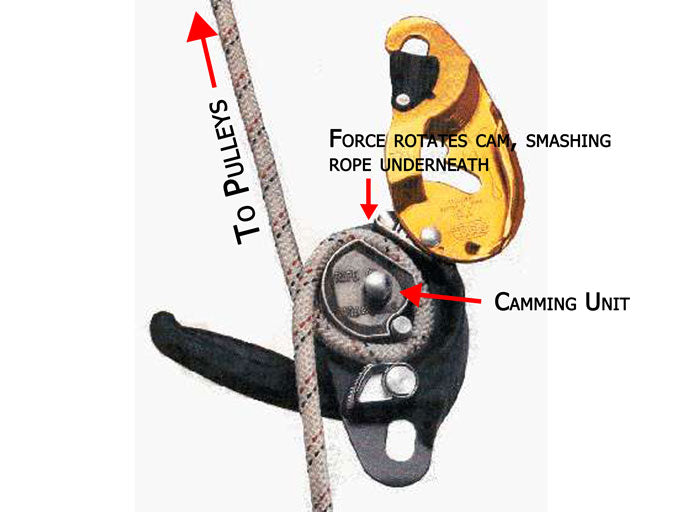
Camming Device Brake

Using this method of braking, it is necessary for the rope to change directions. For this reason, the larger the camming piece, the less friction there will be within the device. The devices with smaller camming units will typically be much more difficult to release tension as well, because of the much higher friction within the device (plus, these devices will typically have smaller handles for releasing tension).

Another braking method that is quite common does not have an official name, but we will refer to them as "Smashing-Method Brakes". It's typically found on certain types of ATC's (belay devices) and involves taking the loaded end of the rope and using it to smash the rope tail such that it is not able to move.
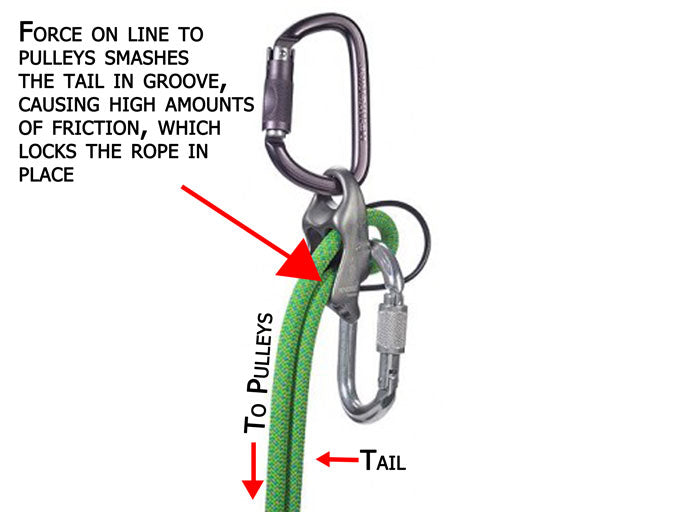
Rope Smashing Brake

This method involves a very large amount of friction and can rob a significant amount of your mechanical advantage. Another thing about these types of brakes is that they require the use of a smaller diameter of rope because the groove in which the rope is smashed is usually quite small and can destroy larger ropes. The benefit of these types of brakes is that they are quite cheap compared to the far superior camming-type brakes.

Ease of Tension Release

One of the most dangerous parts of rigging a slackline is releasing tension from the line. If you have a brake that has a lot of control when releasing tension, detensioning can become very easy and very safe. One of the easiest ways to tell if a brake will be easy to release tension from is the size of the handle on the device. Some devices have a VERY small handle, or no handle at all (read: Grigri and all smashing-method brakes), which makes releasing tension extremely difficult and quite dangerous. There have been many instances where I have seen people come very close to getting severly injured during detensioning using one of these devices.

Most devices that use the camming-method to brake will be significantly easier to detension than their smashing-method counterparts. This is because these devices typically come with a handle that can be controlled very well, even under extreme tensions. Although, the longer the handle the device has, the easier the release of tension will be. This is due to the amount of torque you have on releasing the camming device: the longer the handle, the more torque you have.

Strength

This topic is a hard one to cover since most devices that we use for braking our tensioning system are not meant for this application. They are typically belay devices that happen to work perfectly for our sport. Typically, how these types of devices are strength rated is by 'person load'. For instance, the Petzl GriGri 2 does not have any published breaking strength, but it is typically used as a single person belay device. This means that it's capable of holding a factor 2 fall in rock climbing, which can be upwards of 8 kN of force on the device. This type of loading is known as shock loading, and is completely different from a sustained load. I typically suggest that you limit the force on your GriGri 2 to about 600 lbf, which is roughly 3,000 lbf if using a 5:1 pulley system (whole other post).

Other brake devices publish their strength limitations as they are often used for rescue situations where sustained loads are more common. For instance, on Petzl's website (www.Petzl.com) they have a chart in which they show test results of pulling on ropes which were anchored with the Petzl RIG, and they were showing slipping loads as low as 4.8 kN (1,079 lbf). This is much higher than the proclaimed 2.7 kN that has been stated for the Petzl GriGri 2.

The best of the best braking devices, such as the CMC MPD, publish their actual breaking strengths and decent control loads. These are the most trusted devices for this application because they are built for holding and releasing tension. However, they cost over $600, which can be quite the turnoff for many. The Petzl Braking Devices offered by Balance Community are a great compromise on quality and price. I have rigged several lines well in excess of 1,000 ft. using any of the devices offered by Balance Community.

Weight

This topic is especially important for pulley systems which are used for highlines. The heavier your brake device, the heavier your pack will be. Typically, a lighter device will be less than optimal in other categories, but sometimes the added weight savings is worth the lower strenth rating, difficulty of detensioning, and unfavorable braking method. However, there are devices out there that have a moderate weight and excell in other categories, such as the Petzl RIG. An awesome device in a small package (more later).

Keep in mind that heavier brake devices are heavier for a reason: they have bigger components. For instance, the CMC MPD weighs in at 2 lbs 8 oz., and that's because it comes with a 3" steel sheave and has stainless steel sideplates. The Petzl RIG weighs in at 380 grams and has a camming unit that is roughly 1/3 the size of the CMC MPD's sheave. It's all about where you are using your brake though, if weight is not an issue, then heavier usually means stronger and less friction.

Price

As with any gear related items (or anything, pretty much), you get what you pay for. Don't let the price fool you though! Sometimes a cheaper brake will better suite your needs compared to a much more expensive one. For instance, if you are planning on doing a highline with a massive approach, it would probably be a good idea to avoid the CMC MPD and stick with the Petzl GriGri 2 instead, as it's about 1/6 the weight. So just take in to account all the above characteristics as well as the projects that you will be working on before deciding on a brake device.


This ends the first part of this article. Next I would like to take a look at some specific brakes and their characteristics to help you get a better idea of what you can expect when shopping for brake devices.

Petzl REVERSO 3

Petzl REVERSO 3
  • Braking Method: Smashing Method
  • Ease of Tension Release: Difficult to Extremely Difficult
  • Strength: Difficult to say. The suggested loads for this device are under 250 lbf, which is when it becomes nearly impossible to release tension.
  • Weight: 77 grams (2.72 ounces)
  • Price: $34.95

The good ol' REVERSO 3, such a handy device for belaying people and lowering loads, but it's quite the painful device for braking your pulley system. The EXTREMELY high friction that this device has destroys nearly all of your mechanical advantage. Don't get me wrong though, if you are on a budget and want to have a brake that will work for slacklines up to 200 feet, then the REVERSO 3 will work for you. Just do not expect to be able to tension your slacklines very easily...

To add insult to injury, to detension lines with the REVERSO 3, you must install a puller chord to the front hole, which makes detensioning quite the ordeal. It's very easy to do this the wrong way or too quickly and have the full tension of your line come exploding through the device at full velocity. I have done it and so have a few other people out there, so just be careful when detensioning your lines when using the REVERSO 3.

Petzl REVERSO 3 Pull Chord

Petzl Grigri 2

Petzl GRIGRI 2
  • Braking Method: Camming Method
  • Ease of Tension Release: Moderate to Difficult
  • Strength: Difficult to say. Slipping begins to occur at roughly 600 lbf on static loads. Tension becomes nearly impossible to release past 500 lbf.
  • Weight: 185 grams (6.5 ounces)
  • Price: $94.95

The GRIGRI 2 is Petzl's latest creation in the belay device department and it's quite the upgrade from the previous version. It now accepts ropes as little as 8.9mm in diameter and has better decent control. How this translates into our slackline realm is that you can now use a smaller rope in your pulley system (which means less weight) and releasing tension is a bit easier. However, the drawbacks are still there with the redesign: you still can't rig lines beyond 400 ft. with a 5:1 pulley system (simply because the device will be nearly impossible to open), and you have to be very careful when detensioning because it's possible to accidently fully open the camming device and have the full tension explode out of the device. Just redirect the rope behind the brake when releasing tension (as the instructions say to do) and slowly pull on the handle and you should be fine.

I would definitely recommend getting yourself a Petzl Grigri 2 if you are looking into a moderate brake device for a decent amount of money that will work for lines up to 400 feet long with about 8 ft. of sag. I have used mine for a few years now and it still works like a charm (the GRIGRI 1, that is).

Petzl RIG

Petzl RIG
  • Braking Method: Camming Method
  • Ease of Tension Release: Moderate to Easy
  • Strength: Meant for single person loads on rescue type situations. Petzl suggests staying below 330 lbf (150 kgf), but the soonest the rope should start slipping is 4.8 kN (1,079 lbf). Petzl advertises a 14 kN breaking strength.
  • Weight: 340 grams (12.0 ounces)
  • Price: $150.00

The RIG is Petzl's latest creation in the Professional scene. A slimmed down I'D with all the extra features shaved off for those professionals that don't need them (like us slackliners). Some of these features are: the safety cam for those times when you install the rope backwards and the safety catch on the release handle for when you open the cam too far. The RIG still has the openable sideplate for installing the rope while the device is still connected to the anchor, which is really awesome. This plus the moderate cost is what sold me on it.

This device is one of my favorite brakes because it's pretty lightweight, has a nice size camming device for less friction, and is pretty easy to release tension from. However, it lacks the safety catch that the I'D has which takes some getting used to (if you've used the I'D before). I really like to use the RIG for lines in the 300-400 ft. range and most highlines because it's pretty small and easy to use.

Petzl I'D Small

Petzl I'D Small
  • Braking Method: Camming Method
  • Ease of Tension Release: Easy to Very Easy
  • Strength: Meant for single to double person loads in rescue type situations. Petzl suggests staying below 550 lbf (250 kgf) for sustained loads, but the device is rated at 14 kN minimum breaking strenth (MBS).
  • Weight: 530 grams (18.7 ounces)
  • Price: $225.00

The I'D is a wonderful device which is great for BIG projects. I have had mine for just over 3 years (as of October, 2011) and it still works perfectly. There are a few annoying things about it that I wish were not there though. Such as, the safety cam that is there just in case I install the rope backwards. This thing gets in the way SO much when I'm tensioning my lines. I wish there was a way to remove it. The large cam on the device is very nice because there is very limited friction during tensioning. The safety catch on the tension release handle is nice sometimes when the tensions are super high. My friend would have had some SERIOUS rope burns if that safety catch were not there. He was releasing tension on a 1600 ft. line while sitting on the anchor and he pulled the handle on the I'D too hard and the rope came FLYING through the device. The safety catch kicked in at the very last second, leaving 3" of tail coming out of the brake. Had it not caught, the rope would have unravelled completely through the device and he would have fallen to the ground while getting slapped by the extremely fast travelling rope. Needless-to-say, we were all thankful that we brought the I'D that day.

I really like the fact that you can keep the I'D attached to the anchor while you install the rope. There have been many times where I have almost dropped my GRIGRI when trying to install the rope on a highline tensioning system. With all that being said, I would only ever choose the I'D over the RIG if I was planning on doing REALLY big lines (over 800 feet long) where the added strength and larger cam were necessary.

CMC Multi Purpose Device (MPD)

CMCMPD
  • Braking Method: Highly Advanced Camming Method
  • Ease of Tension Release: Very East to EXTREMELY Easy
  • Strength: Decent Control (tension release) is rated at 24 kN (5,395 lbf) for 13mm version and 21 kN (4,721 lbf) for 11mm version. Minimum Breaking Strength of 44 kN (9,891 lbf).
  • Weight: 1100 grams (38.8 ounces)
  • Price: $650.00

The best of the best braking device. SO easy to use, such high efficiency, ultra strong, and built for lowering massive loads. With a built in 3" sheave (pulley) that only spins in one direction, a specialized camming device that was machined out of stainless steel, and extremely advanced lowering mechanism, the MPD is the way to go for the serious slackliner. With such a high rating, you can even get away with have a 3:1 main pulley system instead of a 5:1 using this device. I wish I had $650 lying around to get myself one of these bad boys. Perhaps Santa Clause will be nice to me this year :).

Here's a nice table showing the differences between the five brakes above:

Attribute Petzl REVERSO 3 Petzl GRIGRI 2 Petzl RIG Petzl I'D S CMC MPD
Braking Method Smashing Method Camming Method Camming Method Camming Method High-Strength Camming Method
Ease of Tension Release Difficult to Extremely Difficult Moderate to Difficult Moderate to Easy Easy to Very Easy Very East to EXTREMELY Easy
Strength Under 250 lbf Under 500 lbf Under 330 lbf. MBS of 14 kN. Under 550 lbf. MBS of 14 kN Decent Control: 21 - 24 kN, MBS of 44 kN
Weight 77 grams (2.72 ounces) 185 grams (6.5 ounces) 340 grams (12.0 ounces) 530 grams (18.7 ounces) 1100 grams (38.8 ounces)
Price $34.95 $94.95 $150.00 $225.00 $650.00

This concludes the Brakes article in the 'All About Your Pulley System' series from Slack Science. Stay tuned for more articles from this series in coming weeks!

Rate this blog entry:
2
Tags: Array

Comments

  • Kyle Friday, 14 October 2011

    Great info! You have any experience with the SMC Spider? Same price point as the RIG, I can't find data regarding how much force it will hold, breaking strength is right up there with the RIG. I love SMC's build quality.

  • Slack Science Tuesday, 18 October 2011

    I haven't had much experience with using the SMC Spider, but it seems like a wonderful brake. The only issue is that it is quite heavy for it's caliber (567 grams or 1.25 lbs). The handle is very long which most likely makes it very easy to release tension. I haven't seen any literature on how much holding power it has though.

    Another downside I can see is that it requires larger ropes than the other brake devices. It's made by SMC though, so it has to be high quality.

Leave your comment

Guest Wednesday, 19 June 2013

These articles take a lot of time and research. Help keep Slack Science afloat with a small donation. Every little bit helps.

Amount: 

Categories
