Customer Login

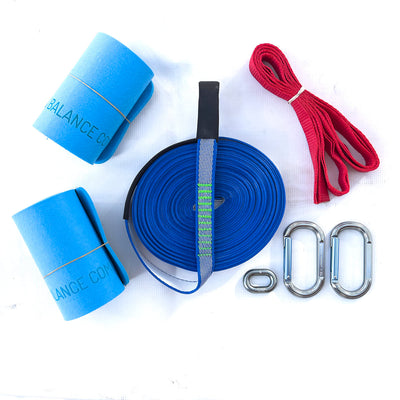
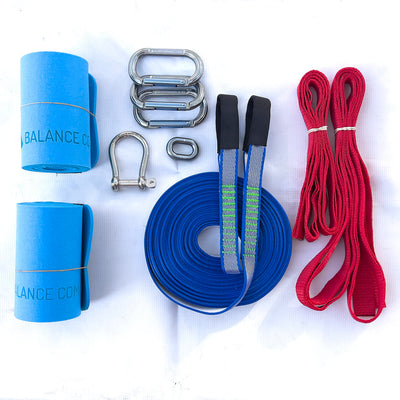
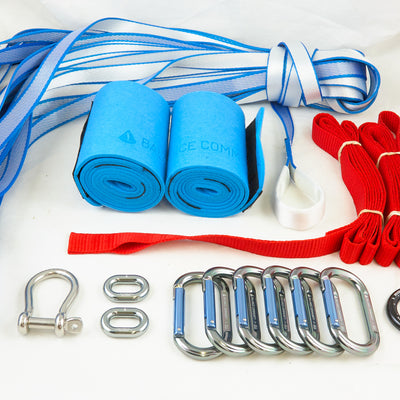
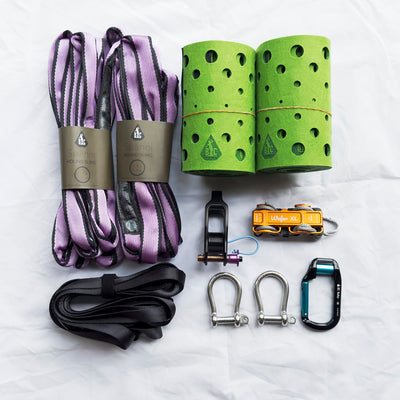
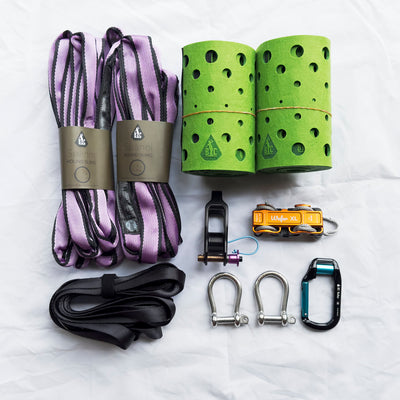
The Titen Series Custom Slackline Kit Builder is a completely customizable slackline kit. With the base level products selected, you can rig lines up to 200 ft. long by yourself. The top notch options provide enough efficiency and strength to rig lines up to 1,500 feet long.

With different options and an array of different configurations to choose from, you can build your slackline kit the way you want it to be! Save money by building your kit with the Titen Series Custom Slackline Kit Builder, which is cheaper than buying the products individually from the shop.

Follow the instructions below to build your slackline kit. When you click on an item on the left column, information about that specific product will pop-up in the right hand column. You can then click on the details button to view more information about that specific product. All included accessories will be mentioned in the short description of the product in the right hand column. If you have any questions, feel free to Contact Us.

Show/Hide details

Webbing

This is the slackline webbing that you will be walking on. The type of line you get totally depends on your style of slacklining. Click on each type of webbing to learn more about that specific webbing.
The prices are per foot. Please enter the number of feet you need in the quantity box below.

$

Webbing Anchor - Static End

These devices are what your slackline webbing will be attached to. You then will attach the device to your anchor sling. We have a variety of devices for different types of slacklines. You can choose to get different types of anchors for either side of your line (static end and tensioning end) depending on how you like to setup your line. This will be the webbing anchor that attaches directly to your Anchor Sling on the non-tensioning side of the slackline. Read more about each type of anchor by selecting them from the list below.

$
Qty 
1

Webbing Anchor - Tensioning End

These devices are what your slackline webbing will be attached to. You then will attach the device to your anchor sling. We have a variety of devices for different types of slacklines. You can choose to get different types of anchors for either side of your line (static end and tensioning end) depending on how you like to setup your line. This will be the webbing anchor that attaches to your pulley system. Read more about each type of anchor by selecting them from the list below.

$
Qty 
1

Anchor Slings

These slings are what your slackline will be attached to. For the most part, you will be using trees as your anchor points, so you will need a pair of slings to wrap around the tree that are strong enough to hold the high forces inherent with slacklining. The slings we offer for these kits are built to withstand serious tensions and abrasions. This makes them the perfect solution for anchoring any slackline.

$

Pulley System - 1 - Main Pulleys

These are the powerhouse for your pulley system. The job of the main pulleys is to hold the full force of the line. The efficiency is not as important as the brute strength of the pulleys. Choose pulleys that have a working load limit that is inline with how much tension you plan on putting on your line. For instance, if you plan on putting forces up to 2,500 lbf on your slackline, you should be using the stronger SMC 3" Double Pulleys. However, if weight is a big priority for you and you only need 1,800 lbs of tension on your line, the Rock Exotica Machined Doubles would be a better choice.

$
Qty 
1

Pulley System - 2 - Brake

This is the piece of the tensioning system that is holding all the force. Choose a brake that holds the size rope you will be using and can hold the amount of force you will be putting on your line. Remember that with a 5:1 pulley system, the brake is holding 1/5 of the total force and with a 9:1 pulley system, t's holding 1/9 of the total tension.

$
Qty 
1

Pulley System - 3 - Attachment Point

The attachment point is an optional piece of the tensioning system. Having a rigging plate consolidates the gear on the tensioning end as well as spaces everything out for easier rigging. However, you can get by without one if you use the embedded brake technique, which is described in the Slack Science Articles below.

$
Qty 
1

Pulley System - 4 - Static Rope

The rope that will be running through your pulleys on the pulley system. To determine the length of rope you will need, you will need to know the length and stretch of your webbing as well as the mechanical advantage of your pulley system. For instance, if you have 300 feet of Type-18 webbing and a 5:1 pulley system, you will need 300 x 11% x 5 = 165 feet of rope. This is length of webbing x stretch at working load x mechanical advantage of your pulley system. A good length to consider would be 150 feet for most lines under 400 feet. There are certain techniques for using shorter ropes than usual, which will be shown in a Slack Science article.

$

Multiplier - 5a - Rope Grab

The part of your multiplier that grabs onto the static rope. This point in the system will be holding three times the force that you are pulling on the rope. That means that if you are pulling 100 pounds of force on the pulley rope, there will be 300 lbs of force applied to the Multiplier Rope-Grab. For this reason, you should use the strongest option possible as to not damage your rope.

$
Qty 
1

Multiplier - 5b - Pulley

The source of all your power! The multiplier pulley is responsible for 2/3 of your efficiency in the pulley system, so having the most efficient pulley possible for this point in the system is best!

$
Qty 
1

Multiplier - 5c - Handled Ascender

$
Qty 
1

Haul Bag

Various sizes of haul bags for carrying your slackline gear around. Choose the different sizes below to see the characteristics of each.

$
Qty 
1
Total Price :  $


NOTE: When selecting certain products for the pulley system, extra items may be automatically added to your card. These items are to ensure you have a complete kit and are necessary to build your slackline correctly. The added items are at a discounted price which will ultimately save you money from purchasing the items individually. Feel free to Contact Us with any questions. ATTENTION: There are many possible configurations to choose from above. A great way to learn about the different sections of the kit is to read through the Slack Science articles referred to in each group. If you still have questions about choosing a kit that's right for you, feel free to Contact Us with your questions.